Deterministic RNG streams and reusable noise update helpers. More...
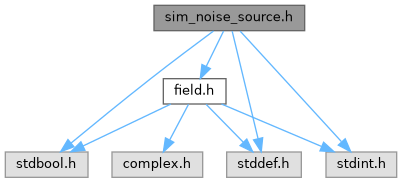
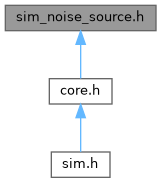
Go to the source code of this file.
Classes | |
| struct | SimNoiseSourceRng |
| Mutable deterministic RNG state with cached normal sample. More... | |
Typedefs | |
| typedef struct SimNoiseSourceRng | SimNoiseSourceRng |
| Mutable deterministic RNG state with cached normal sample. | |
Functions | |
| void | sim_noise_source_seed (SimNoiseSourceRng *rng, uint64_t initstate, uint64_t initseq) |
| Seed a deterministic RNG stream. | |
| double | sim_noise_source_uniform (SimNoiseSourceRng *rng) |
| Draw a uniform variate in [0, 1). | |
| void | sim_noise_source_normal_pair (SimNoiseSourceRng *rng, double *n0, double *n1) |
| Draw a pair of independent standard-normal variates. | |
| double | sim_noise_source_normal (SimNoiseSourceRng *rng) |
| Draw one standard-normal variate. | |
| double | sim_noise_source_gaussian_gain (double sigma, double dt, bool scale_by_dt) |
| Compute the finite gain used by Gaussian white-noise updates. | |
| SimResult | sim_noise_source_ensure_capacity (double **real_state, SimComplexDouble **complex_state, size_t *capacity, size_t count, bool is_complex) |
Ensure reusable temporal-noise state storage has at least count entries. | |
| void | sim_noise_source_apply_white_real (double *dst, size_t count, double mean, double gain, SimNoiseSourceRng *rng) |
| Add real-valued white Gaussian noise to an array in place. | |
| void | sim_noise_source_apply_white_complex (SimComplexDouble *dst, size_t count, double mean_re, double mean_im, double gain_re, double gain_im, SimNoiseSourceRng *rng) |
| Add complex white Gaussian noise to an array in place. | |
| void | sim_noise_source_temporal_params (double sigma, double tau, double alpha, double dt, double *out_decay, double *out_variance) |
| Derive decay and innovation scale for temporal correlated noise. | |
| void | sim_noise_source_apply_temporal_real (double *dst, double *noise_state, size_t count, double output_scale, double decay, double variance, SimNoiseSourceRng *rng) |
| Advance real temporal-noise state and add it to a destination array. | |
| void | sim_noise_source_apply_temporal_complex (SimComplexDouble *dst, SimComplexDouble *noise_state, size_t count, double output_scale, double decay, double variance, SimNoiseSourceRng *rng) |
| Advance complex temporal-noise state and add it to a destination array. | |
| void | sim_noise_source_apply_mean_reverting_real (double *dst, size_t count, double mean, double decay, double variance, SimNoiseSourceRng *rng) |
| Apply a real mean-reverting update in place. | |
| void | sim_noise_source_apply_mean_reverting_complex (SimComplexDouble *dst, size_t count, double mean, double decay, double variance, SimNoiseSourceRng *rng) |
| Apply a complex mean-reverting update in place. | |
Detailed Description
Deterministic RNG streams and reusable noise update helpers.
This header exposes the shared stochastic primitives used by stimulus and noise operators. Streams are explicitly seeded, output buffers are caller-owned, and helper functions clamp non-finite parameters to deterministic fallbacks rather than propagating NaN through update loops.
Typedef Documentation
◆ SimNoiseSourceRng
| typedef struct SimNoiseSourceRng SimNoiseSourceRng |
Mutable deterministic RNG state with cached normal sample.
The state/inc pair implements the underlying uniform stream. The spare fields cache the second Box-Muller output so repeated scalar-normal calls consume the same sequence as paired normal generation.
Function Documentation
◆ sim_noise_source_apply_mean_reverting_complex()
| void sim_noise_source_apply_mean_reverting_complex | ( | SimComplexDouble * | dst, |
| size_t | count, | ||
| double | mean, | ||
| double | decay, | ||
| double | variance, | ||
| SimNoiseSourceRng * | rng | ||
| ) |
Apply a complex mean-reverting update in place.
The same real mean is applied to both real and imaginary channels, with independent Gaussian innovations when variance is nonzero.
- Parameters
-
[in,out] dst Complex values to update in place. count Number of entries in dst.mean Reversion target for both channels. decay Distance-from-mean multiplier. variance Optional standard-normal innovation multiplier. rng RNG state to advance when variance is nonzero.
◆ sim_noise_source_apply_mean_reverting_real()
| void sim_noise_source_apply_mean_reverting_real | ( | double * | dst, |
| size_t | count, | ||
| double | mean, | ||
| double | decay, | ||
| double | variance, | ||
| SimNoiseSourceRng * | rng | ||
| ) |
Apply a real mean-reverting update in place.
Each element becomes mean + decay * (x - mean) plus optional Gaussian innovation. Non-finite parameters fall back to mean=0, decay=1, variance=0.
- Parameters
-
[in,out] dst Real values to update in place. count Number of entries in dst.mean Reversion target. decay Distance-from-mean multiplier. variance Optional standard-normal innovation multiplier. rng RNG state to advance when variance is nonzero.
◆ sim_noise_source_apply_temporal_complex()
| void sim_noise_source_apply_temporal_complex | ( | SimComplexDouble * | dst, |
| SimComplexDouble * | noise_state, | ||
| size_t | count, | ||
| double | output_scale, | ||
| double | decay, | ||
| double | variance, | ||
| SimNoiseSourceRng * | rng | ||
| ) |
Advance complex temporal-noise state and add it to a destination array.
Real and imaginary state channels use independent normal innovations.
- Parameters
-
[in,out] dst Destination values incremented by output_scale * state. [in,out] noise_state Persistent per-element complex noise state. count Number of entries in both arrays. output_scale Scale applied to updated channels before adding to dst. decay Autoregressive decay factor. variance Multiplier for fresh standard-normal innovations. rng RNG state to advance.
◆ sim_noise_source_apply_temporal_real()
| void sim_noise_source_apply_temporal_real | ( | double * | dst, |
| double * | noise_state, | ||
| size_t | count, | ||
| double | output_scale, | ||
| double | decay, | ||
| double | variance, | ||
| SimNoiseSourceRng * | rng | ||
| ) |
Advance real temporal-noise state and add it to a destination array.
- Parameters
-
[in,out] dst Destination values incremented by output_scale * state. [in,out] noise_state Persistent per-element real noise state. count Number of entries in both arrays. output_scale Scale applied to the updated state before adding to dst. decay Autoregressive decay factor. variance Multiplier for fresh standard-normal innovation. rng RNG state to advance.
◆ sim_noise_source_apply_white_complex()
| void sim_noise_source_apply_white_complex | ( | SimComplexDouble * | dst, |
| size_t | count, | ||
| double | mean_re, | ||
| double | mean_im, | ||
| double | gain_re, | ||
| double | gain_im, | ||
| SimNoiseSourceRng * | rng | ||
| ) |
Add complex white Gaussian noise to an array in place.
Real and imaginary channels draw independent standard-normal samples. Non- finite means or gains are treated as zero.
- Parameters
-
[in,out] dst Complex destination values to increment. count Number of entries in dst.mean_re Real-channel deterministic offset. mean_im Imaginary-channel deterministic offset. gain_re Real-channel normal multiplier. gain_im Imaginary-channel normal multiplier. rng RNG state to advance.
◆ sim_noise_source_apply_white_real()
| void sim_noise_source_apply_white_real | ( | double * | dst, |
| size_t | count, | ||
| double | mean, | ||
| double | gain, | ||
| SimNoiseSourceRng * | rng | ||
| ) |
Add real-valued white Gaussian noise to an array in place.
Non-finite mean and gain are treated as zero. The destination is unchanged when dst, rng, or count is empty.
- Parameters
-
[in,out] dst Real destination values to increment. count Number of entries in dst.mean Deterministic offset added to each element. gain Multiplier for independent N(0, 1) samples. rng RNG state to advance.
◆ sim_noise_source_ensure_capacity()
| SimResult sim_noise_source_ensure_capacity | ( | double ** | real_state, |
| SimComplexDouble ** | complex_state, | ||
| size_t * | capacity, | ||
| size_t | count, | ||
| bool | is_complex | ||
| ) |
Ensure reusable temporal-noise state storage has at least count entries.
The selected real or complex state array is allocated or grown with new slots zero-initialized. Passing count zero frees both arrays and resets capacity.
- Parameters
-
[in,out] real_state Pointer to caller-owned real state storage. [in,out] complex_state Pointer to caller-owned complex state storage. [in,out] capacity Current and resulting number of allocated entries. count Required element count; zero releases both arrays. is_complex Selects which state array must be grown for nonzero count.
◆ sim_noise_source_gaussian_gain()
| double sim_noise_source_gaussian_gain | ( | double | sigma, |
| double | dt, | ||
| bool | scale_by_dt | ||
| ) |
Compute the finite gain used by Gaussian white-noise updates.
Non-finite sigma or dt values are treated as zero. When scale_by_dt is true, the gain is multiplied by sqrt(abs(dt)).
- Parameters
-
sigma Noise amplitude. dt Simulation timestep. scale_by_dt Whether to apply sqrt(abs(dt)) scaling.
- Returns
- Finite gain value, or 0.0 if the computed gain is non-finite.
◆ sim_noise_source_normal()
| double sim_noise_source_normal | ( | SimNoiseSourceRng * | rng | ) |
Draw one standard-normal variate.
- Parameters
-
rng RNG state to advance.
- Returns
- A cached or newly sampled N(0, 1) value, or 0.0 when
rngis NULL.
◆ sim_noise_source_normal_pair()
| void sim_noise_source_normal_pair | ( | SimNoiseSourceRng * | rng, |
| double * | n0, | ||
| double * | n1 | ||
| ) |
Draw a pair of independent standard-normal variates.
Uses Box-Muller sampling with the first uniform clamped away from zero to avoid log(0). Output pointers may be NULL.
- Parameters
-
rng RNG state to advance; NULL writes zeroes to non-NULL outputs. [out] n0 Receives the first N(0, 1) sample when non-NULL. [out] n1 Receives the second N(0, 1) sample when non-NULL.
◆ sim_noise_source_seed()
| void sim_noise_source_seed | ( | SimNoiseSourceRng * | rng, |
| uint64_t | initstate, | ||
| uint64_t | initseq | ||
| ) |
Seed a deterministic RNG stream.
- Parameters
-
rng RNG state to initialize; NULL is ignored. initstate Initial generator state value. initseq Stream selector; converted to an odd increment internally.
◆ sim_noise_source_temporal_params()
| void sim_noise_source_temporal_params | ( | double | sigma, |
| double | tau, | ||
| double | alpha, | ||
| double | dt, | ||
| double * | out_decay, | ||
| double * | out_variance | ||
| ) |
Derive decay and innovation scale for temporal correlated noise.
The update convention is state = decay * state + variance * N(0, 1). Invalid dt disables innovation, invalid tau is clamped to a tiny positive value, and alpha is bounded below by 0.1.
- Parameters
-
sigma Innovation amplitude before temporal normalization. tau Positive correlation timescale. alpha Positive stretch exponent, clamped to at least 0.1. dt Simulation timestep. [out] out_decay Receives decay factor when non-NULL. [out] out_variance Receives normal multiplier when non-NULL.
◆ sim_noise_source_uniform()
| double sim_noise_source_uniform | ( | SimNoiseSourceRng * | rng | ) |
Draw a uniform variate in [0, 1).
- Parameters
-
rng RNG state to advance.
- Returns
- Uniform double in [0, 1), or 0.0 when
rngis NULL.