Backend abstraction layer for libsimcore execution engines. More...
#include <stdbool.h>#include <stddef.h>#include <stdint.h>#include "oakfield/field.h"#include "oakfield/kernel_ir.h"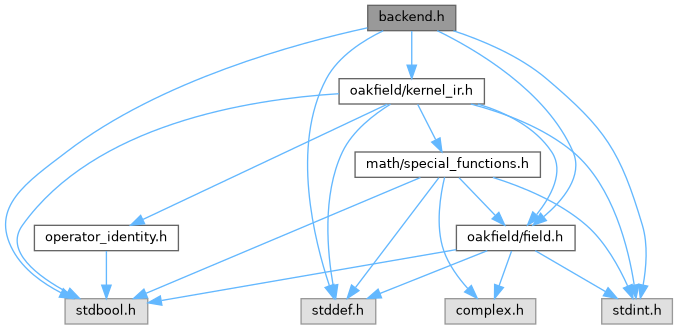

Go to the source code of this file.
Classes | |
| struct | SimKernelIRBinding |
| Field binding made available to a compiled kernel. More... | |
| struct | SimKernelIROutput |
| Output specification emitted by a kernel. More... | |
| struct | KernelIR |
| KernelIR package describing the executable graph for a backend. More... | |
| struct | SimBackend |
| Runtime backend handle shared across implementations. More... | |
Typedefs | |
| typedef enum SimBackendType | SimBackendType |
| Identifies the concrete backend implementation in use. | |
| typedef enum SimBackendFeature | SimBackendFeature |
| Compute backend feature flags indicating supported capabilities. | |
| typedef struct SimKernelIRBinding | SimKernelIRBinding |
| Field binding made available to a compiled kernel. | |
| typedef struct SimKernelIROutput | SimKernelIROutput |
| Output specification emitted by a kernel. | |
| typedef enum SimKernelComplexSemantics | SimKernelComplexSemantics |
| Declares how complex-valued IR lanes should be interpreted by backends. | |
| typedef struct KernelIR | KernelIR |
| KernelIR package describing the executable graph for a backend. | |
| typedef struct SimBackend | SimBackend |
| Runtime backend handle shared across implementations. | |
Enumerations | |
| enum | SimBackendType { SIM_BACKEND_TYPE_CPU = 0 , SIM_BACKEND_TYPE_CUDA , SIM_BACKEND_TYPE_METAL } |
| Identifies the concrete backend implementation in use. More... | |
| enum | SimBackendFeature { SIM_BACKEND_FEATURE_NONE = 0ULL , SIM_BACKEND_FEATURE_ANALYTIC_WARP = 1ULL << 0 , SIM_BACKEND_FEATURE_BOUNDARY_AWARE_DIFFS = 1ULL << 1 } |
| Compute backend feature flags indicating supported capabilities. More... | |
| enum | SimKernelComplexSemantics { SIM_KERNEL_COMPLEX_SEMANTICS_TRUE_COMPLEX = 0 , SIM_KERNEL_COMPLEX_SEMANTICS_COMPONENTWISE } |
| Declares how complex-valued IR lanes should be interpreted by backends. More... | |
Functions | |
| void | backend_init (SimBackend *backend) |
| Initialize a backend instance. | |
| void | backend_launch (SimBackend *backend, KernelIR *kernel) |
| Launch a kernel on the selected backend implementation. | |
| void | backend_destroy (SimBackend *backend) |
| Tear down a backend instance and release owned resources. | |
| bool | sim_backend_cpu_vdsp_enabled (const SimBackend *backend) |
| Query whether the CPU backend currently uses vDSP fast paths. | |
| void | sim_backend_cpu_set_vdsp_enabled (SimBackend *backend, bool enabled) |
| Enable or disable vDSP fast paths on the CPU backend at runtime. | |
Detailed Description
Backend abstraction layer for libsimcore execution engines.
Backends execute KernelIR graphs against bound simulation fields. The public contract is intentionally small: callers initialize a SimBackend, launch a KernelIR package, inspect last_error, and destroy the backend when its implementation-specific resources are no longer needed.
In the standalone CMake package, the CPU backend is the reference backend. CUDA and Metal are experimental optional backends; requests return SIM_RESULT_NOT_FOUND unless the matching optional backend support is compiled in.
Typedef Documentation
◆ KernelIR
KernelIR package describing the executable graph for a backend.
The package is caller-owned for the duration of backend_launch(). Backends may cache compiled artifacts keyed by the builder and emitted source, but they do not take ownership of fields, bindings, outputs, params, or builder storage.
◆ SimBackend
| typedef struct SimBackend SimBackend |
Runtime backend handle shared across implementations.
impl is private to the selected backend type. Callers should initialize the handle with backend_init() before launch and release it with backend_destroy().
◆ SimBackendFeature
| typedef enum SimBackendFeature SimBackendFeature |
Compute backend feature flags indicating supported capabilities.
KernelIR packages can require features such as analytic warp nodes or boundary-aware finite differences. A backend must advertise all required bits before it is a valid execution target for that kernel.
◆ SimKernelComplexSemantics
| typedef enum SimKernelComplexSemantics SimKernelComplexSemantics |
Declares how complex-valued IR lanes should be interpreted by backends.
True-complex semantics apply complex algebra to two-lane values. Componentwise semantics allow backends to treat each lane independently, which enables simpler pointwise fast paths for selected kernels.
◆ SimKernelIRBinding
| typedef struct SimKernelIRBinding SimKernelIRBinding |
Field binding made available to a compiled kernel.
Bindings connect KernelIR field identifiers to runtime field storage and layout metadata. Shape and stride arrays are measured in elements, not bytes; when they are NULL, helper code may fall back to the field layout.
◆ SimKernelIROutput
| typedef struct SimKernelIROutput SimKernelIROutput |
Output specification emitted by a kernel.
Each output writes one expression root to one bound destination field. The destination field must be present in the KernelIR binding table.
Enumeration Type Documentation
◆ SimBackendFeature
| enum SimBackendFeature |
Compute backend feature flags indicating supported capabilities.
KernelIR packages can require features such as analytic warp nodes or boundary-aware finite differences. A backend must advertise all required bits before it is a valid execution target for that kernel.
| Enumerator | |
|---|---|
| SIM_BACKEND_FEATURE_NONE | No optional capabilities. |
| SIM_BACKEND_FEATURE_ANALYTIC_WARP | Analytic warp IR nodes. |
| SIM_BACKEND_FEATURE_BOUNDARY_AWARE_DIFFS | Boundary-aware finite differences. |
◆ SimBackendType
| enum SimBackendType |
◆ SimKernelComplexSemantics
Declares how complex-valued IR lanes should be interpreted by backends.
True-complex semantics apply complex algebra to two-lane values. Componentwise semantics allow backends to treat each lane independently, which enables simpler pointwise fast paths for selected kernels.
| Enumerator | |
|---|---|
| SIM_KERNEL_COMPLEX_SEMANTICS_TRUE_COMPLEX | Use true complex algebra semantics. |
| SIM_KERNEL_COMPLEX_SEMANTICS_COMPONENTWISE | Treat lanes independently/componentwise. |
Function Documentation
◆ backend_destroy()
| void backend_destroy | ( | SimBackend * | backend | ) |
Tear down a backend instance and release owned resources.
The handle is left with no advertised features and last_error set to SIM_RESULT_OK. Passing NULL is a no-op.
- Parameters
-
[in,out] backend Backend instance to destroy.
◆ backend_init()
| void backend_init | ( | SimBackend * | backend | ) |
Initialize a backend instance.
The requested backend->type selects CPU, CUDA, or Metal. Unknown types are normalized to CPU. On failure, SimBackend::last_error stores the encountered error code and backend-specific implementation storage is not considered valid.
- Parameters
-
[in,out] backend Backend instance to initialize.
◆ backend_launch()
| void backend_launch | ( | SimBackend * | backend, |
| KernelIR * | kernel | ||
| ) |
Launch a kernel on the selected backend implementation.
The backend writes results into the fields named by kernel->outputs. On failure, SimBackend::last_error stores the encountered error code.
- Parameters
-
[in,out] backend Backend instance executing the kernel. [in,out] kernel Kernel description to execute; storage remains caller-owned.
◆ sim_backend_cpu_set_vdsp_enabled()
| void sim_backend_cpu_set_vdsp_enabled | ( | SimBackend * | backend, |
| bool | enabled | ||
| ) |
Enable or disable vDSP fast paths on the CPU backend at runtime.
Calls against non-CPU backends or builds without vDSP support are ignored.
- Parameters
-
backend Backend to mutate. enabled Whether vDSP fast paths should be attempted.
◆ sim_backend_cpu_vdsp_enabled()
| bool sim_backend_cpu_vdsp_enabled | ( | const SimBackend * | backend | ) |
Query whether the CPU backend currently uses vDSP fast paths.
- Parameters
-
backend Backend to inspect.
- Returns
- True only for initialized CPU backends compiled with vDSP support and currently configured to use those paths.